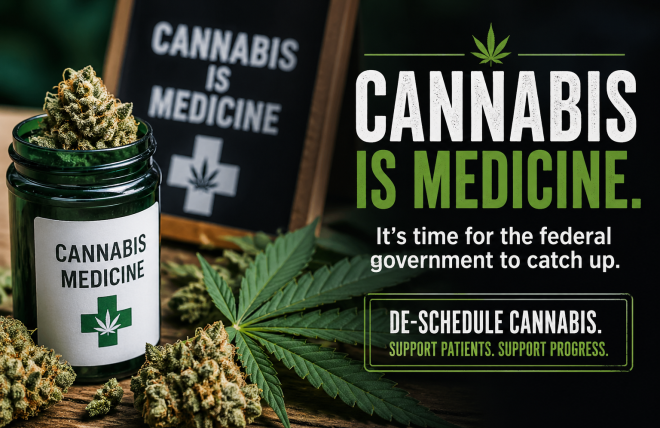
Cannabis Is Medicine: Why Federal De-Scheduling Is the Only Real Solution

Introduction: The Reality vs. Federal Policy
Across the United States, tens of millions of people every day are already using cannabis as medicine.
They’re using it to sleep, to manage pain, to reduce anxiety, and to improve quality of life. In states like Michigan, this isn’t controversial—it’s normal.
But at the federal level, cannabis policy still hasn’t caught up.
Despite growing acceptance and widespread use, cannabis remains entangled in outdated regulation under the Controlled Substances Act—a framework that continues to limit research, restrict access, and create unnecessary barriers for patients and businesses alike.
Cannabis Is Already Being Used as Medicine
You don’t need to look far to see cannabis being used therapeutically—it’s happening every day.
Consumers rely on cannabis for:
- Chronic pain and inflammation
- Sleep disorders and insomnia
- Anxiety and stress management
- Appetite stimulation and nausea relief
- Neurological conditions, including seizure disorders
For many, cannabis isn’t a last resort—it’s a preferred alternative to traditional pharmaceuticals that often come with heavier side effects.
This is not a fringe trend. It’s a fundamental shift in how people approach wellness and a shift back to how humans have used cannabis for the last ten thousand years or so.
The Science: Understanding the Endocannabinoid System
Modern research has identified the endocannabinoid system (ECS)—a critical biological system present in all humans.
The ECS helps regulate key functions such as:
- Mood and emotional balance
- Sleep cycles
- Pain perception
- Immune response
Cannabinoids like THC and CBD interact directly with this system, helping the body maintain homeostasis (balance).
This is why cannabis can have such a broad range of effects—it’s working with a system that already exists throughout the body. Every organ in you has cannabinoid receptors. Think about that, your body knows exactly what to do with cannabis. That is why so many people use it for relief from various ailments, it works with your body.
The Federal Disconnect: Schedule I vs. Schedule III
Cannabis has long been classified as a Schedule I substance under federal law—defined as having “no accepted medical use.”
That classification is completely out of step with reality. It always has been out of step, even if more people believed it. In 1850 cannabis shows up in the United States Pharmacopoeia for the first time. Companies created patented medicine using cannabis for 87 years in this country before it was banned in 1937.
Recently, the U.S. Department of Health and Human Services recommended reclassification, and the Drug Enforcement Administration has proposed moving cannabis to Schedule III.
What This Means
- Schedule III would acknowledge medical value
- Research barriers would be reduced
- The industry would gain legitimacy
But here’s the key point:
Rescheduling is progress—but it’s not the finish line.
Why Rescheduling Cannabis Isn’t Enough
Moving cannabis to Schedule III would help—but it still keeps cannabis within the Controlled Substances Act.
That means:
- Federal control remains in place
- Regulatory complexity continues
- Access and innovation are still limited
In other words, it treats cannabis as something that must be tightly controlled—rather than something that should be properly understood and responsibly integrated.
The Real Solution: De-Scheduling Cannabis
If the goal is a fair, functional, and science-based system, the answer is clear:
Cannabis needs to be fully de-scheduled. If you want to replace it with a different substance, maybe consider putting alcohol on as a Schedule I substance. It meets the definition, no medicinal value and a high likelihood of abuse. But I digress....
De-scheduling would:
- Remove cannabis from the Controlled Substances Act entirely
- Eliminate outdated federal restrictions
- Allow full-scale medical research without unnecessary barriers
- Create fairer conditions for businesses and patients
Most importantly, it would align federal policy with reality.
How Current Policy Hurts Patients and Progress
Keeping cannabis under federal control doesn’t just impact businesses—it directly affects patients and scientific advancement.
Limited Research
For decades, federal restrictions have made it difficult to conduct large-scale, high-quality studies on cannabis.
Less research doesn’t mean less medical value—it means less opportunity to study it properly.
Restricted Access
Patients in legal states have access, but federal policy still creates:
- Inconsistent regulations
- Limited medical standardization
- Barriers to broader healthcare integration
Slower Innovation
From product development to medical applications, innovation is held back by regulatory uncertainty and federal oversight.
Why This Matters Now More Than Ever
The cannabis industry has already evolved:
- States have legalized it
- Consumers are embracing it
- Science is beginning to catch up
But federal policy is still lagging behind.
Even with a potential move to Schedule III, the system remains incomplete and unfair to the people that need cannabis and don't have safe, affordable access.
Final Thoughts: Aligning Policy with Reality
Cannabis is not an emerging concept—it’s an established part of how millions of people manage their health and well-being.
The question is no longer whether cannabis has medical value.
The real question is:
When will federal policy finally reflect what patients, consumers, and science already understand?
Until that happens, the industry—and the people it serves—will continue operating in a system that doesn’t fully acknowledge reality, which seems to be more and more common these days.
FAQ: Cannabis as Medicine and Federal Policy
Is cannabis officially considered medicine in the U.S.?
Not at the federal level yet. However, many states recognize cannabis for medical use, and millions of consumers use it therapeutically.
What is the difference between rescheduling and de-scheduling cannabis?
Rescheduling moves cannabis to a lower category within the Controlled Substances Act.
De-scheduling removes it entirely, eliminating federal control under that system.
Would de-scheduling make cannabis fully legal?
Yes, at the federal level. However, states would still regulate cannabis individually.
Why is cannabis research limited?
Federal classification has historically restricted access for researchers, making large-scale studies more difficult to conduct.